Evolution of screw foundations
In modern construction, solutions that reduce construction time and minimize soil disturbance are increasingly used. The geoscrew is a logical evolution of traditional screw piles — an engineered system designed for controlled load-bearing capacity and stable foundation performance.
Unlike early types of screw piles, a geoscrew does not merely “hold” in the soil; it interacts with it as a unified system.
What a geoscrew is from an engineering perspective
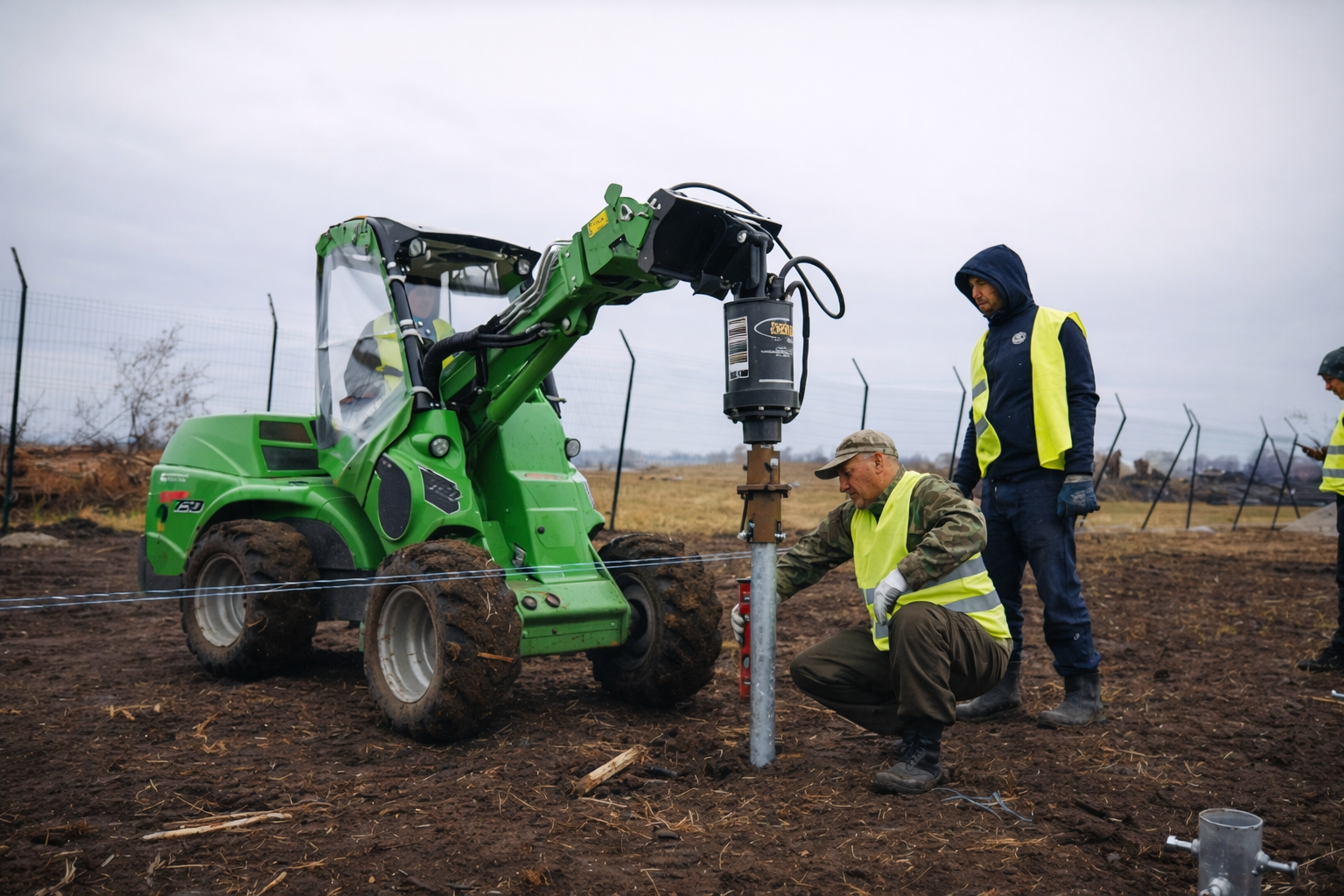
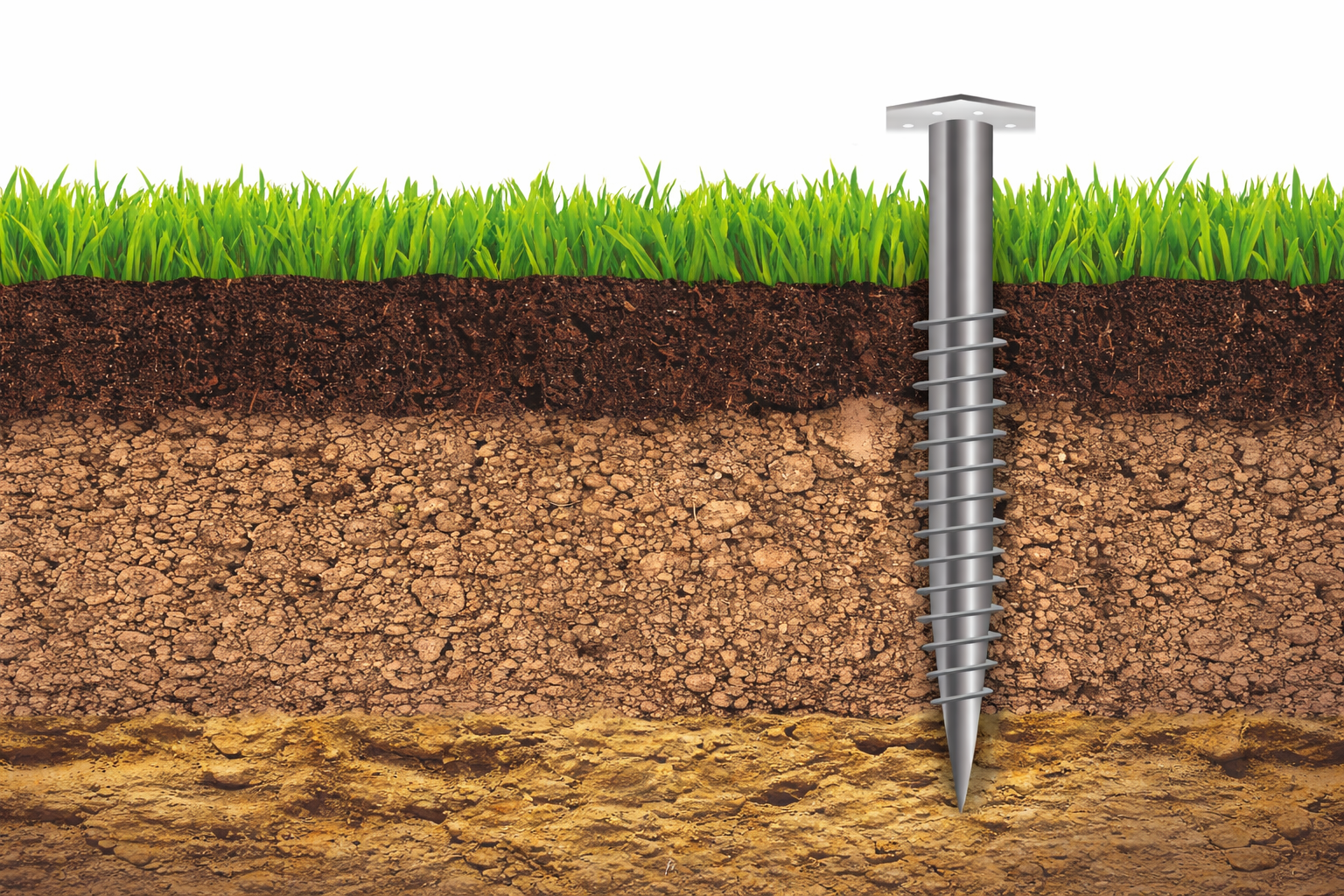
A geoscrew is a steel tube with specially shaped blades that is installed into the ground by screwing. The shape and geometry of the blades are key to its performance.
During installation, the geoscrew:
- does not loosen the soil;
- does not create voids;
- compacts the surrounding soil with each turn.
As a result, a densified zone forms around the pile, providing the foundation’s stable load-bearing capacity.
How a geoscrew transfers loads
Unlike concrete foundations, where loads are transmitted through the mass of the structure, a geoscrew works through mechanical interaction with the soil.
The blades of the geoscrew:
- distribute the load evenly along the pile shaft;
- reduce stress concentration in the upper soil layers;
- ensure stability even in water-saturated conditions.
This principle allows the foundation to reach design load-bearing capacity immediately after installation, without waiting for curing or settling.
Main components of a geoscrew
Structurally, a geoscrew consists of several key elements:
- tip — facilitates initial screwing;
- cone — stabilizes entry into the soil;
- shaft — transmits loads from the structure;
- helical blades — the main element that generates load-bearing capacity.
The helical blades are responsible for soil interaction and determine how the foundation behaves under load.
Head: connection to the structure
A key feature of the geoscrew is the head — the element that connects the foundation to the superstructure.
Different types of heads are used depending on the project:
- hexagonal — for general applications;
- square — for metal and modular constructions;
- u-shaped — for beams and grillages.
In renewable energy projects, particularly solar PV systems, flange-free geoscrews are often used, simplifying installation and allowing precise alignment of PV supports.
Why geoscrews are stable
The stability of a geoscrew is ensured by three factors:
- proper blade geometry;
- soil compaction during installation;
- control over screwing parameters.
This makes the geoscrew a controllable engineering tool rather than just a metal post in the ground.
Expert conclusion from PILLAR
A geoscrew is not a simplified alternative to concrete, but an engineered solution that works according to clear physical principles. Its effectiveness is based on interaction with the soil rather than material mass.
PILLAR’s experience shows that with correct design and installation, geoscrews provide stable load-bearing capacity, precise foundation geometry, and significant reduction in construction time. This is why they are widely used in residential, industrial, and energy projects where predictable engineering performance is essential.