Foundation as an Engineering Solution, Not a Material
In professional practice, foundations are often chosen out of habit — “this is how it has always been done.” However, modern projects increasingly face constraints related to deadlines, equipment access, seasonality, and site impact. Under these conditions, the question of “ground screws or concrete” is no longer a matter of preference but an engineering choice.
The key question is not which material is stronger, but which solution performs best under given conditions and provides predictable results.
Conditions of Use: What Determines the Choice of Foundation
The selection of a foundation system is determined by a combination of factors:
- type and heterogeneity of soils;
- groundwater level and seasonal fluctuations;
- design loads and structural geometry;
- project timelines and logistical constraints;
- requirements for reversibility or scalability.
Concrete foundations are traditionally used where large-scale earthworks are possible and there is time for a full cycle — “excavation → formwork → concrete → curing.” Ground screws, on the other hand, are suited for sites with limited access, challenging soils, or tight schedules.
Engineering Logic of Concrete Foundations
Concrete works through mass and bearing area. Its load-bearing capacity develops after strength gain, and the quality of the result largely depends on adherence to the process at each stage.
From an engineering perspective, concrete foundations have clear strengths:
- perform well on level sites;
- suitable for massive structures with uniform loads;
- provide high rigidity when executed correctly.
At the same time, they are sensitive to errors during pouring, temperature conditions, and design changes after work has begun.

Engineering Logic of Ground Screws
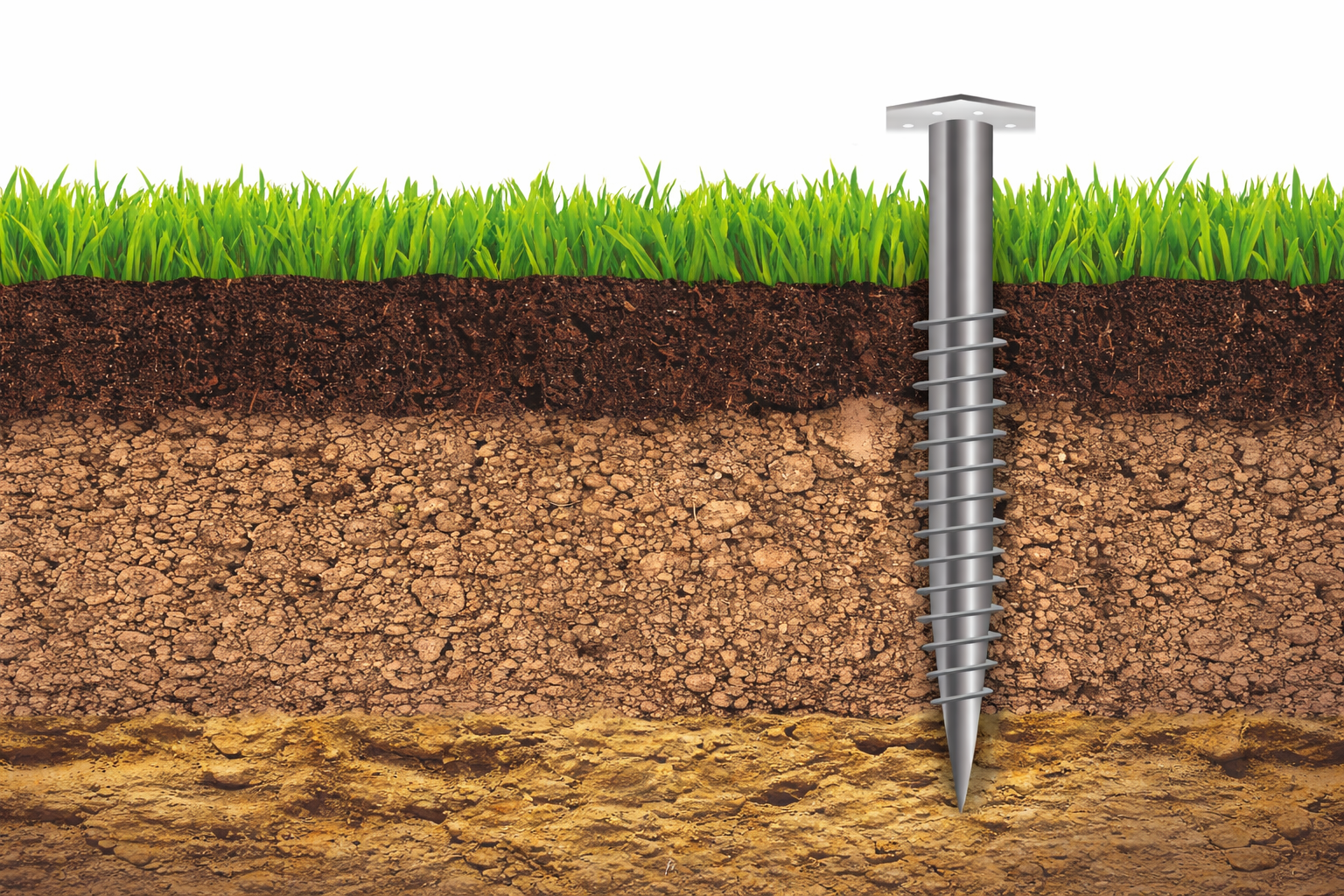
Ground screws operate on a different principle: loads are transferred to the soil through screwing and the interaction of the blades with soil layers. This allows the foundation to achieve load-bearing capacity immediately after installation and enables real-time control.
Engineering advantages of this approach include:
- minimal disturbance to soil structure;
- no wet processes;
- ability to adjust depth and configuration during installation;
- stable geometry of the foundation field.
Ground screws are particularly effective on sites with elevation differences, in water-saturated soils, or where concrete work is difficult.

Implementation Practice: Installation and Control
In practice, the difference between solutions becomes especially noticeable during the implementation stage. A concrete foundation requires a strict sequence of work and time for curing pauses. Any deviation or design change leads to rework.
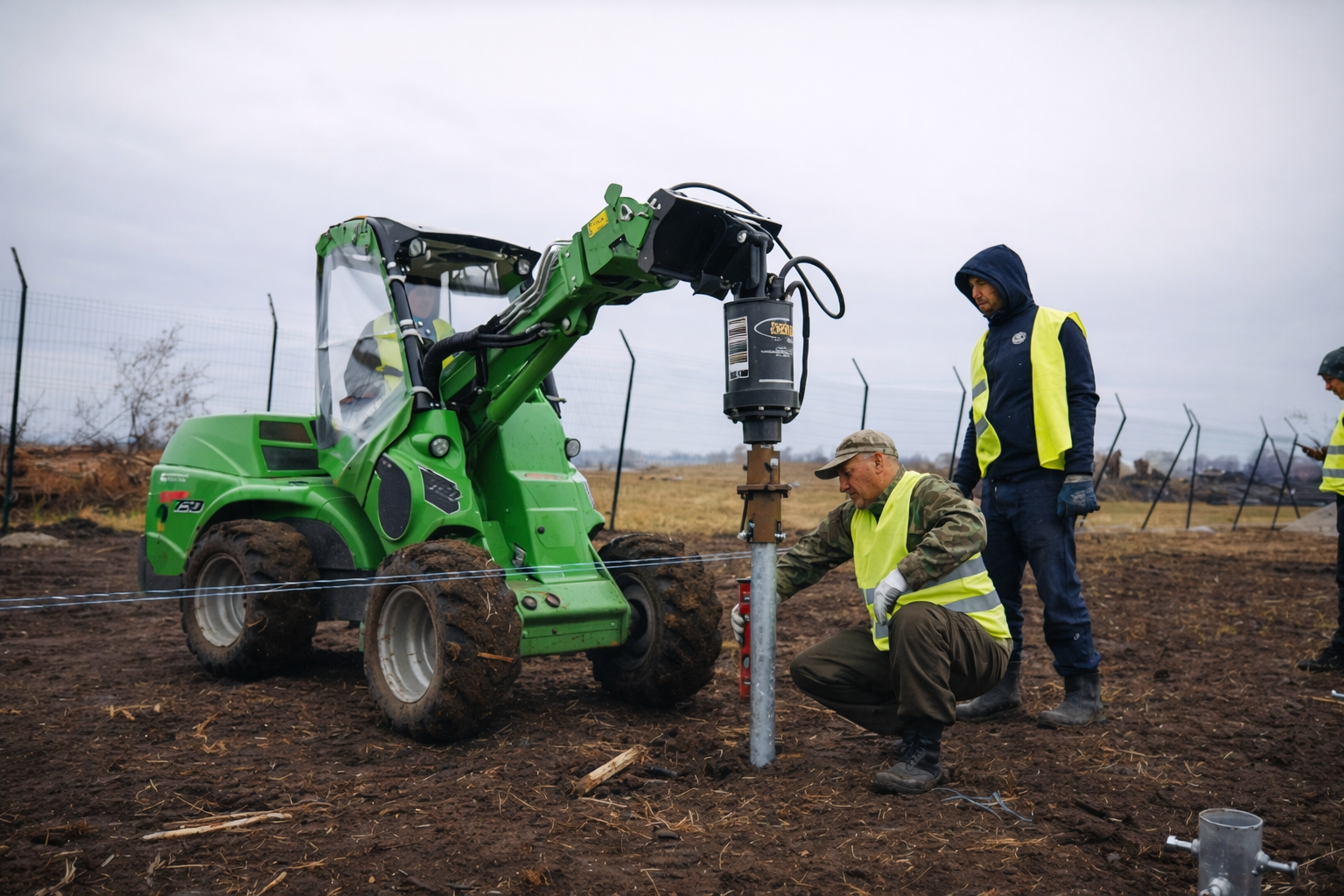
Installation of ground screws is carried out in stages with control of verticality and torque. This allows immediate response to changing soil conditions and achieving design parameters without halting the process.
Operation and Adaptability
In operation, concrete foundations are static: once completed, there is practically no possibility for modifications. Ground screws, on the other hand, allow reinforcement, dismantling, or partial reconfiguration of the foundation without large-scale site intervention.
For temporary, modular, or phased projects, this feature becomes crucial, as it reduces long-term risks.
Engineering Conclusion
Both concrete and ground screws remain fully valid engineering solutions but are suited for different scenarios. Concrete is effective where conditions are stable and the project does not anticipate changes. Ground screws are optimal for projects with high requirements for speed, adaptability, and control of results.
Experience shows that the correct choice of foundation starts not with the material, but with an analysis of project conditions and requirements. This approach ensures a reliable base that works with the structure rather than imposing additional constraints.